Spider
11
ratings
4.2


























.jpg "Minesweeper")


Spider is a challenging game with a larger number of cards, making the arrangement more complex to complete all empty columns in the foundation piles.
The Basic Rules in Spider
In Spider, there are 8 empty slots in the Foundation Piles, and your main goal is to fill all of them using cards from the tableau and stockpile. Completing all foundation piles means you win the game.
Filling the 8 Empty Slots on the Foundation Piles
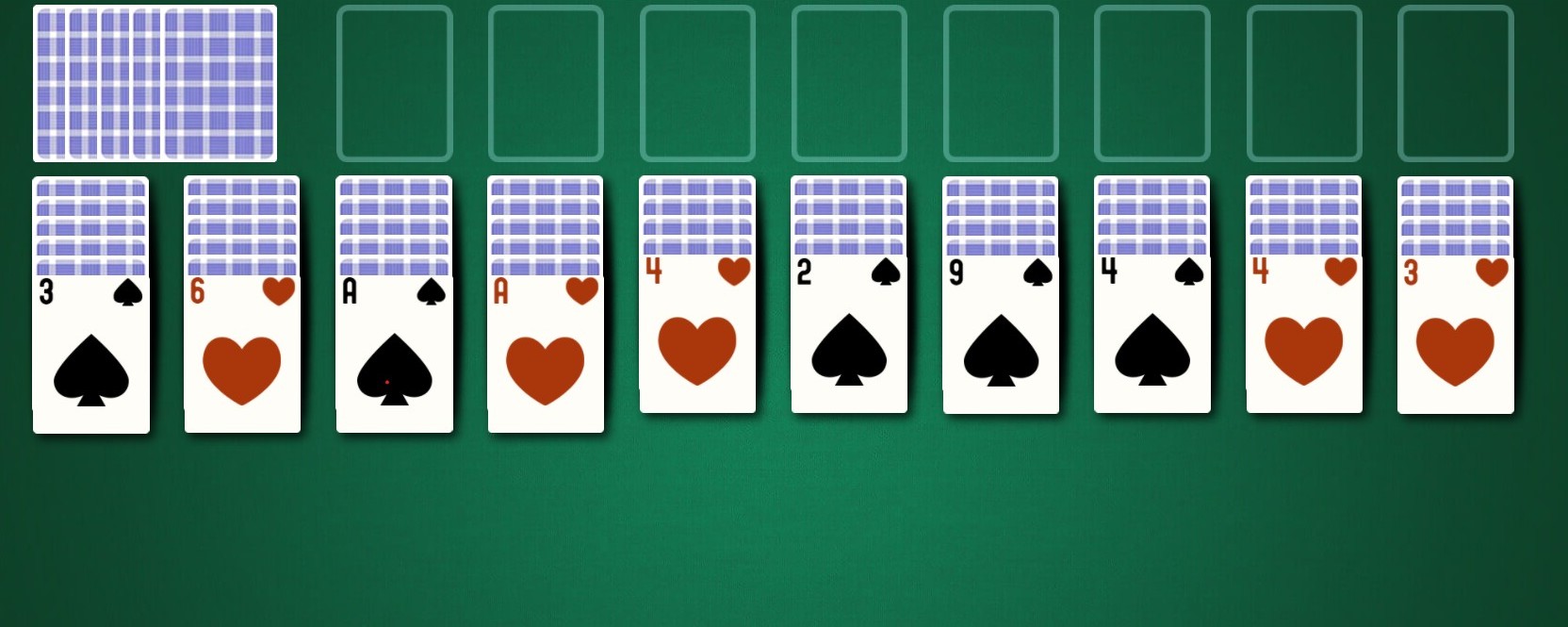
The layout of Spider
Each empty foundation slot can hold one complete sequence from Ace to King. However, cards can only move to the foundation when you successfully build a continuous sequence from King down to Ace on the tableau.
Each foundation pile represents a completed sequence, and since Spider uses 108 cards, the challenge increases significantly compared to other card games.
How to Arrange Cards on the Tableau
The tableau consists of 10 columns, and at the start of the game, 54 cards are dealt onto the tableau.
- You can place a face-up card with a lower value on a face-up card with a higher value.
- No color alternation (red/black) is required.
- Cards can be moved in groups if they form a proper descending sequence
This freedom allows for more creative strategies but also demands careful planning.
How the Stockpile Works in Spider
When no valid moves are available on the tableau, you can click the stockpile located in the top-left corner of the screen.
Once activated, one face-up card is automatically dealt to each tableau column. This mechanic can open new opportunities but may also make the layout more complicated, turning every draw into both an opportunity and a challenge.
The Scoring System in Spider
The maximum score in Spider is 260 points, achieved by moving all 108 cards into the foundation piles.
Time plays a crucial role in ranking. Only players who achieve the maximum score in the shortest amount of time will appear on the leaderboard. Therefore, efficient moves and fast decision-making are key to success.
Difficulty Levels in Spider
Spider offers three main stages, each with increasing difficulty: 1 Suit, 2 Suits, and 4 Suits. Each stage is designed for different skill levels.
1 Suit
The 1 Suit stage includes Easy, Medium, Hard, Expert, Master, and Random modes.
This stage is ideal for beginners and short play sessions. With only one suit in play, forming complete sequences from King to Ace is much easier.
2 Suits
The 2 Suits stage removes Easy and Medium modes, leaving Hard, Expert, Master, Grandmaster, and Random.
This stage is suitable for experienced players who have more time and confidence. Two suits appear, requiring you to complete sequences by suit, increasing complexity.
4 Suits
The 4 Suits stage is the most difficult and includes Expert, Master, Grandmaster, and Random modes.
This is a true battlefield for professional players, where cards must be arranged in strict order across four different suits, demanding advanced planning and precision.
What's the Difference Between Solitaire IO and Spider?
Similarities
- Both games are card-based puzzle games.
- The main objective is to move all cards to the Foundation Piles.
- Both Solitaire IO and Spider feature leaderboards, encouraging competition among players.
Differences
- Spider uses 108 cards, while Solitaire IO uses the standard 52-card deck.
- Spider does not require red-black color alternation.
- Solitaire IO has two main stages (Standard and Las Vegas), while Spider offers three stages: 1 Suit, 2 Suits, and 4 Suits
Although Spider and Solitaire differ greatly in rules, stages, and difficulty, both card games are highly popular and loved by players worldwide.


